
Quintessence
PORTFOLIO · IKEBANA · ONGOING PRACTICE

Ikebana, with Junko
Studying the Japanese art of living flowers with my teacher, Junko
Student of Junko · Film, part one: end of October 2026
WHY IKEBANA
Part of a long line.
Japanese garden design and ikebana share a deep respect for lineage. Skills pass from teacher to student, generation after generation, and nobody pretends they invented any of it. You learn by being shown, then by looking.
Ikebana is often translated as “living flowers”: arranging plants so you notice the line of a stem, the space around it and the season it belongs to. What hooked me was how much it leaves out. Western floristry often asks how full something can be. Ikebana asks what one branch is already saying, and how to stop getting in its way. Most of the work is paying attention. That’s the bit I wanted more of.

MY TEACHER (SHE’D DISAGREE)
Junko
Call Junko a teacher and she’ll put you right. She isn’t a teacher, she says, she’s an introducer. Someone introduced her to ikebana, and now she introduces the rest of us. That’s how a lineage works.
Born in Tokyo, Junko worked as a music journalist and designed gardens in England, and studied ikebana in Kyoto under the 15th-generation grand masters of the Kuwahara Senkei school. Zen practice runs underneath all of it. Her classes sell out.
What I didn’t expect was how little of it is about flowers. It’s about looking properly, for longer than feels comfortable, and trusting what you see. She gave me questions I now ask of everything I make: where’s the line, where’s the space, what season is this, and what can come out?

THE FILM
A conversation with Junko
I sat down with Junko for a long conversation about her life, her teaching and what flowers have shown her. The film is hers, not mine. It’s slow on purpose, so make a brew and let her do the talking.
Part one arrives at the end of October 2026.

Look closer.
Ikebana up close, where it sets the pace.


Where it shows up.
Four places ikebana changes how I work.
GARDENS
Line, space, season
A garden is ikebana you can walk through. It’s why my planting leaves room to breathe.
FLOWERS
Fewer stems, more said
For weddings and occasions: seasonal material that looks like it grew that way, with somewhere for the eye to rest.
WORKSHOPS
Slow on purpose
My mindful floristry workshops borrow ikebana’s pace, its kenzan and its close looking. No experience needed.
STEWARDSHIP
What to take out
Tending a garden through the year is mostly editing. Ikebana taught me that taking away is part of making.
More from the practice.
Where ikebana turns up in work you can book.
LIVERPOOL WOMEN’S HOSPITAL

EXPERIENCES

PORTFOLIO
Christmas ikebana
Mindful floristry
Between Chaos & Order
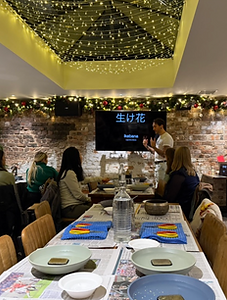
A mindful floristry workshop with hospital staff, everyone taking home their bowl and kenzan. Read the story
Hands-on, unhurried workshops for teams and groups, shaped by ikebana. See the workshops
My first solo show garden at RHS Sandringham 2026. Walk through the garden
WITH THANKS
Made with
Junko
My ikebana teacher. Sorry, introducer. Her story, her words, her film.
The film
Interviewed, filmed and edited by me. Part one is out at the end of October 2026.
Learn from Junko
If this makes you want to try ikebana properly, go to the source. Junko’s classes sell out fast, so book early.
Good to know.
Do you teach ikebana?
No. I’m a student of it, and I’d rather send you to someone who’s spent a lifetime on it. If you want to learn ikebana itself, Junko’s classes are the place to start.
Is your floristry ikebana?
Not strictly. My work mixes Western floristry with what I’ve learned from ikebana: line, space, seasonal material and knowing when to stop. It’s an influence, not a style I’m claiming.
Does it change your gardens?
A lot. It’s why I think about the view from one spot, the gaps between plants and how a space changes through the year, not just how full a border looks in June.
Can I book a workshop?
Yes. My mindful floristry workshops are hands-on, unhurried and for complete beginners. They suit teams, groups and private events.